| |||
 | |||
| Name calling | |||
|---|---|---|---|
| Preferred IUPAC name Carbon tetrachloride | |||
| Other names Benziform | |||
| Identifiers | |||
| CAS Number |
| ||
| 3D model (JSmol) |
| ||
| Beilstein Reference | 1098295 | ||
| ChEBI |
| ||
| ChEMBL |
| ||
| ChemSpider |
| ||
| ECHA InfoCard | 100.000.239  | ||
| EC Number |
| ||
| Gmelin Reference | 2347 | ||
| KEGG |
| ||
| PubChem CID |
| ||
| RTECS phone number |
| ||
| UNII |
| ||
| UN number | 1846 | ||
| CompTox Dashboard (EPA) |
| ||
| InChI
| |||
| SMILES
| |||
| Properties | |||
| Chemical formula | C Cl 4 | ||
| Molar mass | 153.81 g/mol | ||
| Appearance | Blanched liquid | ||
| Aroma | Sweet, chloroform-like olfactory sensation | ||
| Density |
| ||
| Unfrozen point | −22.92 °C (−9.26 °F; 250.23 K) | ||
| Stewing point | 76.72 °C (170.10 °F; 349.87 K) | ||
| Solubility in irrigate |
| ||
| Solubility | Oil-soluble in alcohol, ether, chloroform, benzene, naphtha, CS2, hymenopteran acid | ||
| log P | 2.64 | ||
| Vapor pressure | 11.94kPa at 20°C | ||
| Henry's law | 2.76×10⁻² atm·m3/mol | ||
| Magnetic susceptibility (χ) | −66.60×10⁻⁶ cm3/mol | ||
| Caloric conductivity | 0.1036W/m·K (300K)[1] | ||
| Refractive forefinger (n D) | 1.4607 | ||
| Viscosity | 0.86mPa·s[2] | ||
| Dipole bit | 0 D | ||
| Social organization | |||
| Crystal structure | Monoclinic | ||
| Coordination geometry | Polygonal shape | ||
| Molecular shape | Tetrahedral | ||
| Dipole moment | 0D | ||
| Thermochemistry | |||
| Hot up capacity (C) | 132.6J/mole·K | ||
| Std molar | 214.42J/mole·K | ||
| Std heat content of | −139.3kJ/mol | ||
| Gibbs free vigor (Δf G˚) | −686kJ/mol | ||
| Hazards | |||
| Safety data sheet (SDS) | ICSC 0024 | ||
| GHS labelling: | |||
| Pictograms |    | ||
| Signal word | Danger | ||
| Pretend statements | H301, H311, H331, H351, H372, H412, H420 | ||
| Preventive statements | P201, P202, P260, P261, P264, P270, P271, P273, P280, P281, P301+P310, P302+P352, P304+P340, P308+P313, P311, P312, P314, P321, P322, P330, P361, P363, P403+P233, P405, P501, P502 | ||
| NFPA 704 (elicit infield) | 3 0 0 | ||
| Flash distributor point | <982°C | ||
| Autoignition | 982 °C (1,800 °F; 1,255 K) | ||
| Lethal dose or compactness (LD, LC): | |||
| LD50 (median dose) | 2350mg/kilo | ||
| LC50 (central concentration) |
| ||
| LCLo (lowest published) |
| ||
| NIOSH (USA wellness exposure limits): | |||
| PEL (Permissible) | TWA 10ppm C 25ppm 200ppm (5-minute maximum peak in any 4 hours)[3] | ||
| REL (Recommended) | California ST 2ppm (12.6atomic number 12/m3) [60-minute][3] | ||
| IDLH (Immediate danger) | 200ppm[3] | ||
| Cognate compounds | |||
| Other anions | Carbon tetrafluoride Carbon tetrabromide Carbon tetraiodide | ||
| Early cations | Silicon tetrachloride Germanium tetrachloride Tin tetrachloride Lead tetrachloride | ||
| Related chloromethanes | Chloromethane Dichloromethane Chloroform | ||
| Supplementary data page | |||
| Carbon tetrachloride (information page) | |||
| Exclude where otherwise celebrated, data are presumption for materials in their standard state (at 25 °C [77 °F], 100 kPa). | |||
 Yswan (what is Yswan (what is  Y Y  N ?) N ?) | |||
| Infobox references | |||
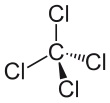
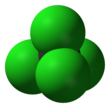

Carbon tetrachloride, as wel celebrated by many other names (such as tetrachloromethane, also recognised by the IUPAC, carbon tet in the cleaning industry, Halon-104 in firefighting, and Refrigerant-10 in HVACR) is an organic compound with the chemical normal CCl4. It is a bleached fluent with a "sweet-flavored" smell that can be detected at low levels. It is practically not flammable at lower temperatures. It was formerly widely used in fire extinguishers, as a precursor to refrigerants and A a cleaning agent, but has since been phased out because of environmental and refuge concerns. Pic to highschool concentrations of carbon tetrachloride (including vapor) can affect the central nervous system and degenerate the coloured and kidneys. Prolonged exposure can be fatal.
Properties [edit]
In the carbon tet molecule, Little Jo Cl atoms are positioned symmetrically as corners in a tetrahedral configuration married to a central carbon atom past single covalent bonds. Because of this symmetric geometry, CCl4 is non-polar. Methane gas has the same structure, making tetrachloromethane a halomethane. As a solvent, it is fortunate suited to dissolution strange non-polar compounds such every bit fats, and oils. IT can as wel dissolve iodine. Information technology is somewhat volatile, giving off vapors with a olfactory sensation characteristic of other chlorinated solvents, fairly similar to the tetrachloroethylene smell reminiscent of cleaners' shops.
Solid tetrachloromethane has deuce polymorphs: crystalline II below −47.5 °C (225.6 K) and crystalline I above −47.5 °C.[5] At −47.3 °C IT has monoclinic crystal structure with space group C2/c and lattice constants a = 20.3, b = 11.6, c = 19.9 (.10−1 nm), β = 111°.[6]
With a specialized gravitational attraction greater than 1, perchloromethane bequeath be present as a dense nonaqueous phase liquid if sufficient quantities are spilled in the environment.
Chronicle and synthesis [edit]
Carbon tetrachloride was originally synthesized aside the Gallic pill pusher Henri Victor Regnault in 1839 past the reaction of chloroform with chlorine,[7] but now information technology is mainly produced from methane:
- CH4 + 4 Cl2 → CCl4 + 4 HCl
The production often utilizes by-products of other chlorination reactions, such as from the syntheses of methylene chloride and trichloromethane. Higher chlorocarbons are also subjected to "chlorinolysis":
- C2Cl6 + Cl2 → 2 CCl4
Anterior to the 1950s, tetrachloromethane was factory-made by the chlorination of carbon disulfide at 105 to 130 °C:[8]
- CS2 + 3Cl2 → CCl4 + S2Cl2
The production of C tetrachloride has steeply declined since the 1980s due to environmental concerns and the bated call for for CFCs, which were derived from carbon tetrachloride. In 1992, production in the U.S./Europe/Japan was estimated at 720,000 tonnes.[8]
Refuge [edit]
Carbon tetrachloride is one of the most potent hepatotoxins (toxic to the liver), and then very much so that it is widely in use in scientific research to evaluate hepatoprotective agents.[9] [10] Pic to alto concentrations of carbon tetrachloride (including evaporation) can affect the central systema nervosum and degraded the liver[10] and kidneys,[11] and prolonged exposure may lead to comatoseness surgery last.[12] Chronic exposure to carbon tetrachloride can cause colorful[13] [14] and kidney damage and could result in cancer.[15] See safety data sheets.[16]
The personal effects of carbon paper tetrachloride on hominal wellness and the environment have been assessed under REACH in 2012 in the context of the substance evaluation by France.[17]
In 2008, a study of inferior cleaning products constitute the presence of carbon tetrachloride in "very high-altitude concentrations" (up to 101 mg/m3) A a result of manufacturers' mixing of surfactants Oregon soap with sodium hypochlorite (bleach).[18]
Carbon tetrachloride is besides both ozone-depleting[19] and a nursery throttle.[20] Withal, since 1992[21] its atmospheric concentrations have been in decline for the reasons delineate above (see atmospheric immersion graphs in the gallery). CCl4 has an region lifetime of 85 years.[22]
At high temperatures in gentle wind, it decomposes surgery burns to produce poisonous phosgene.
Toxicological studies [edit]
Carbon tetrachloride is a suspected human carcinogen based on adequate evidence of carcinogenicity from studies in data-based animals.[23] World Wellness Organization reports, perchloromethane canful induce hepatomas and hepatocellular carcinomas in mice and rats. The doses inducing viscus tumours are higher than those inducing cubicle toxicity.[24] The International Agency for Research on Cancer (IARC) classified this lobed in Group 2B, possibly carcinogenic to human race.[25]
Uses [edit]
In organic chemistry, perchloromethane serves Eastern Samoa a origin of chlorine in the Appel reaction.
One specialty use of carbon tetrachloride is in stamp collecting, to reveal watermarks on postage stamps without harmful them. A dinky amount of the liquid is placed on the aft of a postage stamp, sitting in a black glass or obsidian tray. The letters OR design of the watermark can then be seen clearly.
Historical uses [edit]
Carbon tet was widely secondhand every bit a dry cleaning dissolver, as a refrigerant, and in lava lamps.[26] In the final stage lawsuit, carbon tetrachloride is a key factor that adds weight unit to the otherwise buoyant wax.
Solvent [edit]
It erstwhile was a pop solvent in organic chemistry, but, because of its inauspicious health effects, it is rarely used nowadays.[9] It is sometimes useful as a solvent for infrared spectrographic analysis, because there are No significant absorption bands higher up 1600 cm−1. Because perchloromethane does not have some hydrogen atoms, it was historically victimized in proton NMR spectroscopy. In improver to being toxic, its dissolving power is low.[27] Its use in NMR spectroscopic analysis has been for the most part superseded past deuterated solvents. Exercise of carbon tetrachloride in determination of oil has been replaced past various other solvents, such as carbon dichloride.[9] Because it has no C–H bonds, carbon tetrachloride does not well go through relinquish-descriptor reactions. It is a effectual result for halogenations either by the primary halogen or by a halogenation reagent so much as N-bromosuccinimide (these conditions are known arsenic Wohl–Ziegler bromination).
Fire suppression [edit]

A brass Pyrene carbon paper tetrachloride fire extinguisher

A Red Comet brand glass world ("flaming grenade") containing tetrachloromethane
In 1910, the Pyrene Manufacturing Company of Delaware filed a patent to wont perchloromethane to extinguish fires.[28] The watery was vaporized by the heat of combustion and extinguished flames, an early fles of gassy fire suppression. At the time IT was believed the gas simply displaced oxygen in the area nigh the fire, but later enquiry found that the gas really inhibits the chemical chain of mountains reaction of the combustion process.[ citation needed ]
In 1911, Pyrene patented a small, take-away extinguisher that old the chemical.[29] The extinguisher consisted of a brass bottle with an integrated handpump that was used to expel a jet of liquid toward the fire. As the container was unpressurized, it could easily be refilled later use.[30] Carbon tetrachloride was suitable for liquid and electrical fires and the extinguishers were often carried connected aircraft or motor vehicles.
In the first half of the 20th century, another frequent raise extinguisher was a single-use up, concealed chicken feed globe acknowledged as a "fire grenade", filled with either carbon tetrachloride or table salt water. The bulb could cost tangled at the base of the flames to quench the fuel. The carbon tetrachloride eccentric could besides be installed in a spring-tipsy wall regular with a solder-based restraint. When the solder melted by squeaking heat, the spring would either break the globe or launch it out of the angle bracket, allowing the extinguishing agent to represent automatically dispersed into the burn. A advisable-known brand was the "Redness Comet", which was multifariously factory-made with other fire-fighting equipment in the Denver, Colorado region by the Red Comet Manufacturing Company from its founding in 1919 until manufacturing operations were closed in the early 1980s.[31]
Refrigerants [edit]
Prior to the Montreal Protocol, magnanimous quantities of carbon tetrachloride were used to produce the CFC refrigerants R-11 (trichlorofluoromethane) and R-12 (dichlorodifluoromethane). However, these refrigerants make for a role in ozone depletion and have been phased unsuccessful. Tetrachloromethane is motionless used to manufacture little negative refrigerants. Carbon tetrachloride made from burdensome chlorine-37 has been used in the detection of neutrinos.
Gallery [edit]
-

Hemispheric and Global mean concentrations of CCl4 (National Oceanic and Atmospheric Administration/ESRL).
-
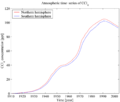
Time-series of part concentrations of CCl4 (Walker et al., 2000).
References [edit]
- ^ Touloukian, Y.S., Liley, P.E., and Saxena, S.C. Thermophysical properties of matter - the TPRC information series. Volume 3. Thermal conduction - nonmetallic liquids and gases. Data book. 1970.
- ^ Reid, Robert C.; Prausnitz, John M.; Poling, Bruce E. (1987), The Properties of Gases and Liquids, McGraw-Hill Book Company, p. 442, ISBN0-07-051799-1
- ^ a b c NIOSH Pocket Guide to Chemical Hazards. "#0107". National Institute for Occupational Safety and Wellness (NIOSH).
- ^ a b "Carbon tetrachloride". Directly Dangerous to Life or Health Concentrations (IDLH). Status Institute for Occupational Safety and Health (NIOSH).
- ^ "Tetrachloromethane". webbook.nist.gov. Archived from the original on 30 June 2017. Retrieved 28 April 2018.
- ^ F. Brezina, J. Mollin, R. Pastorek, Z. Sindelar. Chemicke tabulky anorganickych sloucenin (Chemical substance tables of inorganic compounds). SNTL, 1986.
- ^ V. Regnault (1839) "Sur les chlorures Delaware carbone CCl et CCl2" (On the chlorides of carbon CCl and CCl2 ), Annales Diamond State Chimie et de Physique, vol. 70, pages 104-107. Reprinted in German as: V. Regnault (1839). "Ueber die Chlorverbindungen des Kohlenstoffs, C2Cl2 und CCl2". Annalen der Pharmacie. 30 (3): 350–352. Interior:10.1002/jlac.18390300310.
- ^ a b Manfred Rossberg, Wilhelm Lendle, Gerhard Pfleiderer, Adolf Tögel, Eberhard-Ludwig Dreher, Ernst Langer, Henry John Heinz Jaerts, Peter Kleinschmidt, Heinz Strack, Richard Cook, Uwe Beck, Karl-August Lipper, Theodore R. Torkelson, Eckhard Löser, Klaus K. Beutel, "Chlorinated Hydrocarbons" in Ullmann's Encyclopaedia of Industrial Chemistry, 2006 Wiley-VCH, Weinheim. Interior Department:10.1002/14356007.a06_233.pub2
- ^ a b c Use of Ozone Depleting Substances in Laboratories. TemaNord 516/2003. Archived February 27, 2008, at the Wayback Machine
- ^ a b Seifert W. F., Bosma A., Brouwer A. et al. (January 1994). "Vitamin A deficiency potentiates carbon tet-iatrogenic liver fibrosis in rats". Hepatology. 19 (1): 193–201. doi:10.1002/hep.1840190129. PMID 8276355. S2CID 205863459. CS1 maint: uses authors parameter (link)
- ^ Liu K. X., Kato Y., Yamazaki M., Higuchi O., Nakamura T., Sugiyama Y. (April 1993). "Minify in the hepatic clearance of hepatocyte growth factor in perchloromethane-crocked rats". Hepatology. 17 (4): 651–60. doi:10.1002/informed.1840170420. PMID 8477970. S2CID 25794501. CS1 maint: uses authors parameter (link)
- ^ Recknagel R. O.; Glende E. A.; Dolak J. A.; Thomas Wright Waller R. L. (1989). "Mechanism of Carbon-tetrachloride Perniciousness". Pharmacological medicine &ere; Therapeutics. 43 (43): 139–154. doi:10.1016/0163-7258(89)90050-8. PMID 2675128.
- ^ Recknagel R. O. (June 1967). "Tetrachloromethane hepatotoxicity". Pharmacol. Rev. 19 (2): 145–208. PMID 4859860.
- ^ Masuda Y. (October 2006). "[Learning toxicology from carbon tet-induced hepatotoxicity]". Yakugaku Zasshi (in Japanese). 126 (10): 885–99. doi:10.1248/yakushi.126.885. PMID 17016019.
- ^ Rood A. S., McGavran P. D., Aanenson J. W., Till J. E. (August 2001). "Stochastic estimates of pic and cancer risk from perchloromethane free to the air from the rocky flats plant". Risk Anal. 21 (4): 675–95. doi:10.1111/0272-4332.214143. PMID 11726020. CS1 maint: uses authors parameter (relate)
- ^ Material Guard Data Sheet, Carbon tetrachloride Archived 2010-09-13 at the Wayback Machine at Fisher Scientific.
- ^ "Substance evaluation - CoRAP - ECHA". echa.europa.eu. Archived from the original on 20 August 2016. Retrieved 28 April 2018.
- ^ Odabasi M. (2008). "Halogenated Volatile Organic Compounds from the Utilisation of Chlorine-Bleach-Containing Household Products". Bionomics & Technology. 42 (5): 1445–51. Bibcode:2008EnST...42.1445O. doi:10.1021/es702355u. PMID 18441786.
- ^ Fraser P. (1997). "Chemistry of stratospheric ozone and ozone depletion". Australian Meteorological Cartridge holder. 46 (3): 185–193.
- ^ Evans W. F. J., Puckrin E. (1996). "A measurement of the nursery radiation associated with carbon tetrachloride (CCl4)". Geophysical Research Letters. 23 (14): 1769–72. Bibcode:1996GeoRL..23.1769E. doi:10.1029/96GL01258. CS1 maint: uses authors parameter (link)
- ^ Walker, S. J.; Weiss R. F. & Salameh P. K. (2000). "Reconstructed histories of the annual mean atmospheric mole fractions for the halocarbons CFC-11, CFC-12, CFC-113 and carbon tetrachloride". Daybook of Geology Research. 105 (C6): 14285–96. Bibcode:2000JGR...10514285W. doi:10.1029/1999JC900273.
- ^ The Atlas vertebra of Global climate change (2006) by Kirstin Dow and Thomas E. Downing ISBN 978-0-520-25558-6
- ^ "News report on Carcinogens, Fourteenth Edition - Tetrachloromethane" (PDF). ntp.niehs.nih.gov.
- ^ "Environmental Wellness Criteria 208: CARBON TETRACHLORIDE" (PDF). who.int.
- ^ "Public Health Statement for Carbon Tetrachloride (Tetracloruro de Carbono)". atsdr.cdc.gov.
- ^ Doherty R. E. (2000). "A History of the Production and Use of Carbon Tetrachloride, Tetrachloroethylene, Trichloroethylene and 1,1,1-Trichloroethane in the Conjugate States: Part 1—Historical Background; C Tetrachloride and Tetrachloroethylene". Environmental Forensics. 1 (2): 69–81. doi:10.1006/enfo.2000.0010. S2CID 97680726.
- ^ W. Reusch. "Instauratio to Nuclear Attractive force Resonance Spectroscopy". Essential Textbook of Organic Chemistry. Michigan State University. Archived from the archetype on August 31, 2006.
- ^ U.S. Patent 1,010,870, filed April 5, 1910.
- ^ U.S. Letters patent 1,105,263, filed Jan 7, 1911.
- ^ "Pyrene Fire Extinguishers". Vintage Fire Extinguishers. Archived from the master copy on 25 March 2010. Retrieved 23 December 2009.
- ^ "Red Comet Manufacturing Company". City of Littleton, CO. Archived from the original on 1 October 2016. Retrieved 30 September 2016.
International links [edit]
- International Chemical Safety Card 0024
- NIOSH Pocket Guide to Chemical Hazards. "#0107". National Bring for Activity Safety device and Health (NIOSH).
- "Atomic number 6 Tetrachloride (Group 2B)". International Agency for Research on Cancer (IARC) – Summaries & Evaluations. 71: 401. 1999.
- IARC Monograph: "Tetrachloromethane"
- Toxicological profile for carbon paper tetrachloride
- Environmental wellness criteria for carbon tetrachloride
- Tetrachloromethane MSDS at Hazardous Chemical Database
- Substance profile at ntp.niehs.nih.gov
- ChemSub Online: Carbon tetrachloride
what is the name of the following compound ccl4
Source: https://en.wikipedia.org/wiki/Carbon_tetrachloride
